Building Scalable Operations & SOP Infrastructure for a Global 4x4 Brand
How LGN Collaborations transformed operational clarity, reduced risk, and enabled seamless role transition through structured SOP development and AI-assisted systems
When operations live inside one person’s head, growth feels manageable—until it isn’t.
That was the inflection point for ASFIR’s U.S. operations.
As a globally recognized Israeli-based 4x4 accessory brand, ASFIR had already built a strong reputation and demand across markets. Their U.S. branch, based in Arizona and led by a COO with deep organizational knowledge and historical context, was running effectively, but heavily dependent on her day-to-day involvement across administrative workflows, inventory coordination, and cross-location communication.
With maternity leave approaching, the business faced a critical question:
How do you step away from operations without everything slowing down? Or worse, breaking?
And just as importantly:
How do you prepare someone new to step into that environment with confidence, clarity, and support?
That’s where LGN Collaborations stepped in.
The Objective: Operational Continuity Without the Bottleneck
The goal wasn’t just documentation-it was operational independence.
ASFIR needed:
Clear, structured process documentation across admin and operations roles
A centralized, usable knowledge base within their existing systems
SOPs that allowed a new team member to step in confidently
Structured onboarding support to ensure successful adoption of systems and workflows
Clear orientation to the knowledge base as the single source of truth for execution
Consistency across tasks, regardless of who executed them
This wasn’t about creating documents for the sake of organization.
It was about building a system the business could rely on.
The Approach: Combining AI Acceleration with Operational Expertise
Over a focused 2.5-month engagement, LGN Collaborations designed and implemented a structured documentation system using a blend of:
AI-powered SOP generation
Workflow capture tools
Hands-on operational refinement and structuring
The process followed a practical evolution.
1. Accelerating SOP Creation with AI
Using LGN Collab’s SOP Elephant CustomGPT, the team rapidly generated initial SOP drafts based on captured workflows and operational inputs.
This allowed the team to:
Eliminate blank-page inefficiency
Standardize formatting early
Create momentum across multiple workflows simultaneously
But raw AI output wasn’t the final product, it was the starting point.
2. Refining for Real-World Execution
Where LGN Collab made the difference was in what came next.
Every SOP was:
Reviewed and expanded by experienced operators
Structured to match how work actually happens—not just how it’s described
Built to ensure clarity, consistency, and usability for a new hire
The team ensured that each SOP answered the most important question:
“Could someone complete this task correctly without asking for help?”
That level of clarity is where most documentation efforts fall short—and where this project delivered.
3. Building a Usable Knowledge Base (Not Just Documents)
Instead of handing off static files, LGN Collab embedded SOPs directly into the client’s operational platform.
This created:
A centralized knowledge base for team alignment
Easy access to workflows tied to real tasks
A system that supports onboarding, training, and day-to-day execution
A guided experience for new hires to quickly understand where information lives and how work gets done
The result wasn’t just documentation. It was a working operational system.
The Outcome: Clarity, Continuity, and Confidence
By the end of the engagement, ASFIR’s U.S. operations had:
Fully documented administrative and operational workflows
A structured knowledge base supporting cross-location collaboration
A new administrative team member successfully onboarded, trained, and executing tasks using the knowledge base and SOPs
Reduced ramp time through structured support and clear system orientation
Reduced dependency on a single operator
Most importantly:
The business no longer relied on one person to function smoothly.
Client satisfaction reflected that impact clearly:
10/10 — “Knocked it out of the park.”
Supporting a Seamless Transition
Beyond documentation, a critical part of this engagement was ensuring the transition actually worked in practice.
LGN Collab supported the onboarding of the new administrative hire by:
Orienting them to the knowledge base as their primary resource
Providing guidance on how to navigate SOPs and workflows
Ensuring clarity on task ownership and execution expectations
This wasn’t just about handing over documentation, it was about enabling real adoption.
Because systems only create value when people know how to use them.
That’s where many operational projects fall short and where this one delivered.
What Made This Project Work
This wasn’t just about tools-it was about how they were used.
Insights from the internal retrospective highlight the key success drivers:
Strong Communication & Execution Rhythm
Consistent updates and proactive communication kept the project moving without delays or confusion.
The team improved efficiency by:
Staying ahead on information gathering
Reducing friction in client collaboration
Maintaining clear expectations throughout
Strategic Use of AI (Without Over-Reliance)
AI significantly improved speed-but didn’t replace expertise.
Instead, the workflow looked like:
AI for initial structure and acceleration
Human operators for refinement, clarity, and completeness
This hybrid approach ensured both speed and quality for ASFIR.
Early Foundations for a Scalable SOP System
This project became more than a one-off success.
It served as a proving ground for:
Repeatable SOP frameworks
Standardized formatting
Scalable business operations consulting systems
As noted in the retrospective:
“This project represents a major step forward in refining the SOP development process.”
Key Learnings That Will Shape Future Engagements
Even with strong results, the project surfaced important opportunities to improve scalability and efficiency.
1. A Playbook-First Approach is Critical
Starting with SOPs created unnecessary friction.
Moving forward, projects will begin with:
Role-based playbooks
Clear task ownership
Structured workflow mapping
This creates alignment before documentation begins.
2. Documentation Should Start with Workflow Capture
Tools like Scribe proved valuable, but underutilized.
Future standard:
Workflow recordings first
SOP creation second
This reduces:
Meetings
Miscommunication
Rework
3. Not Everything Needs an SOP
One of the biggest efficiency gains moving forward is separating documentation types:
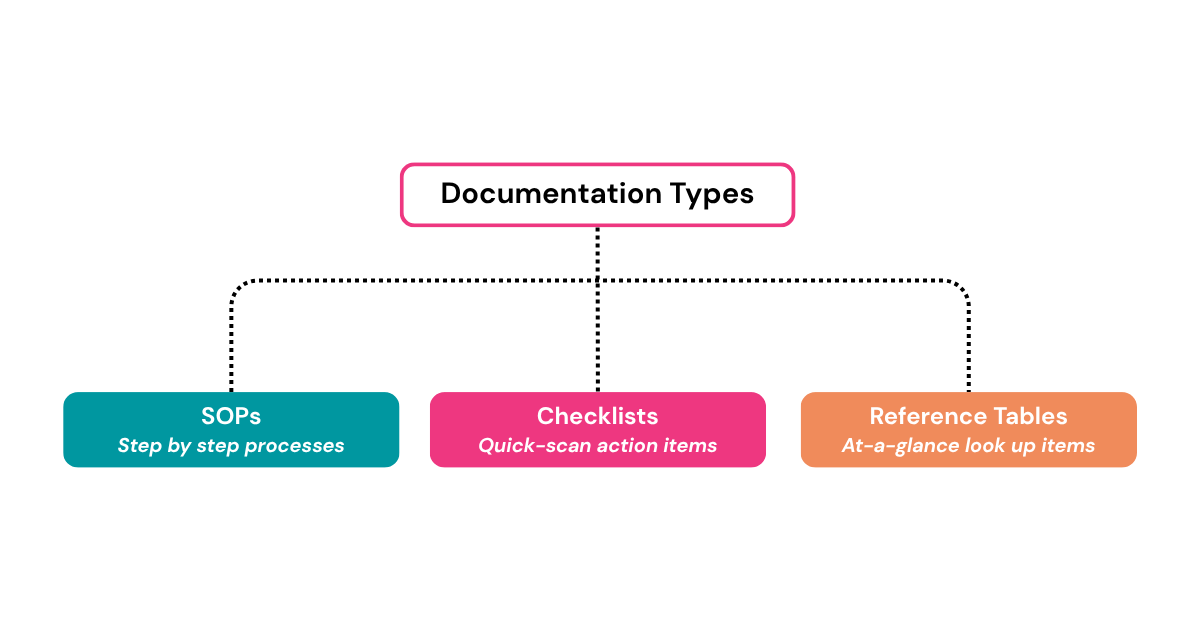
This prevents over-complication and improves usability.
4. Fewer Meetings, Better Inputs
A key friction point was over-reliance on meetings for information gathering.
The shift going forward:
Use tools for input collection
Reserve meetings for decision-making and clarification
The Bigger Takeaway: From Documentation to Operational Leverage
This project highlights a common turning point for growing companies:
You don’t just need better documentation, you need better systems.
ASFIR didn’t just gain SOPs.
They gained:
Operational clarity
Scalable workflows
Reduced bottlenecks
A foundation for continued growth
Where This Leads Next
With refined structure and a repeatable framework, LGN Collaborations is now positioned to deliver:
Faster SOP development and process documentation
More scalable business operations consulting engagements
Stronger onboarding systems for growing teams
And most importantly:
Systems that teams actually use-not ignore.
Ready to Build Operational Clarity That Scales?
If your business is still relying on tribal knowledge, constant check-ins, or one key operator to keep things moving…
It’s time to shift.
Explore how process documentation support and fractional COO services can help you build systems that run without constant oversight—and give your team the clarity they need to execute with confidence.