AI Can Write Your SOPs. It Can't Get Your Team to Follow Them.
AI has made documentation faster than ever, but faster documentation doesn't automatically create better operations. If you've experimented with AI to generate SOPs, workflows, or process documentation, you've probably experienced that initial excitement. Within minutes, you have polished documents that would have taken hours to write manually.
Then reality sets in.
The document looks great, but your team still has questions. Different departments insist the process works differently, ownership is unclear, handoffs are inconsistent, and the beautifully written SOP ends up sitting untouched in a shared folder. The problem isn't the documentation. It's everything that should have happened before the documentation was created.
At LGN Collaborations, we believe successful process documentation support begins long before someone opens an AI tool. While AI has transformed how quickly organizations can create documentation, it hasn't solved the human side of operations: alignment, collaboration, and adoption. That's why our approach emphasizes helping businesses move From Chaos to Clarity by building systems people actually understand and use. It's everything that should have happened before the documentation was created. We unpack exactly what that looks like in our upcoming webinar on August 19.
The Three C's of Effective Documentation
The organizations seeing the greatest success with AI aren't replacing operational conversations, they're improving them.
Here's the framework we use.
1. Clarity Comes Before Documentation
The first draft shouldn't be an SOP, it should be a conversation.
Before documenting anything, your leadership team and process owners need alignment around:
→ Process ownership
→ Roles and responsibilities
→ Decision points
→ Handoffs between teams
→ Success metrics
→ Expected outcomes
Only then does documentation become valuable. It captures the agreed-upon process exceptionally well, but it shouldn't decide what that process should be. Think of AI as the recorder. Not the architect.
2. Collaboration Creates Better Systems
One of the biggest mistakes organizations make is assigning documentation to one person. The operations manager writes it. The founder approves it. Everyone else ignores it.
The strongest documentation is built collaboratively with the people closest to the work. That usually includes the founder, operations leader, project manager, and the team members performing the work every day.
Interestingly, the conversations during process mapping often produce more operational improvement than the finished document itself.
People uncover duplicate work.
Hidden bottlenecks become visible.
Ownership becomes clearer.
Communication gaps emerge naturally.
The documentation is simply the result of those discoveries, not the primary value. This collaborative approach aligns with LGN Collaborations' people-first philosophy of building systems that support both operational efficiency and stronger team alignment, rather than simply creating more documentation.
3. Change Management Determines Whether Documentation Survives
Here's where many organizations stop. Documentation doesn't create adoption, people do. Even the best SOP won't matter if nobody knows it exists, nobody understands why it matters, or leaders don't model the behavior. Without training, reinforcement, and accountability, even the best SOP becomes shelf-ware.
Successful implementation requires:
Leadership modeling the process
Team training
Reinforcement over time
Regular updates and improvements
Otherwise, documentation becomes digital shelf-ware, technically available but practically forgotten. Great SOP development isn't measured by how many documents exist, it's measured by how consistently teams follow them.
Documentation is an Outcome, Not the Goal
When organizations focus only on creating documentation, they often miss the larger opportunity. The real goal isn't producing SOPs, it's creating operational clarity. Documentation simply captures that clarity so it can be repeated, improved, and scaled.
AI is an incredible accelerator for this work, but acceleration only helps if you're headed in the right direction. Without alignment, AI simply helps you document misalignment faster.
Join Us for Our August 19 Webinar
If your organization is using AI, or considering using it, to improve documentation, we'd love to continue the conversation.
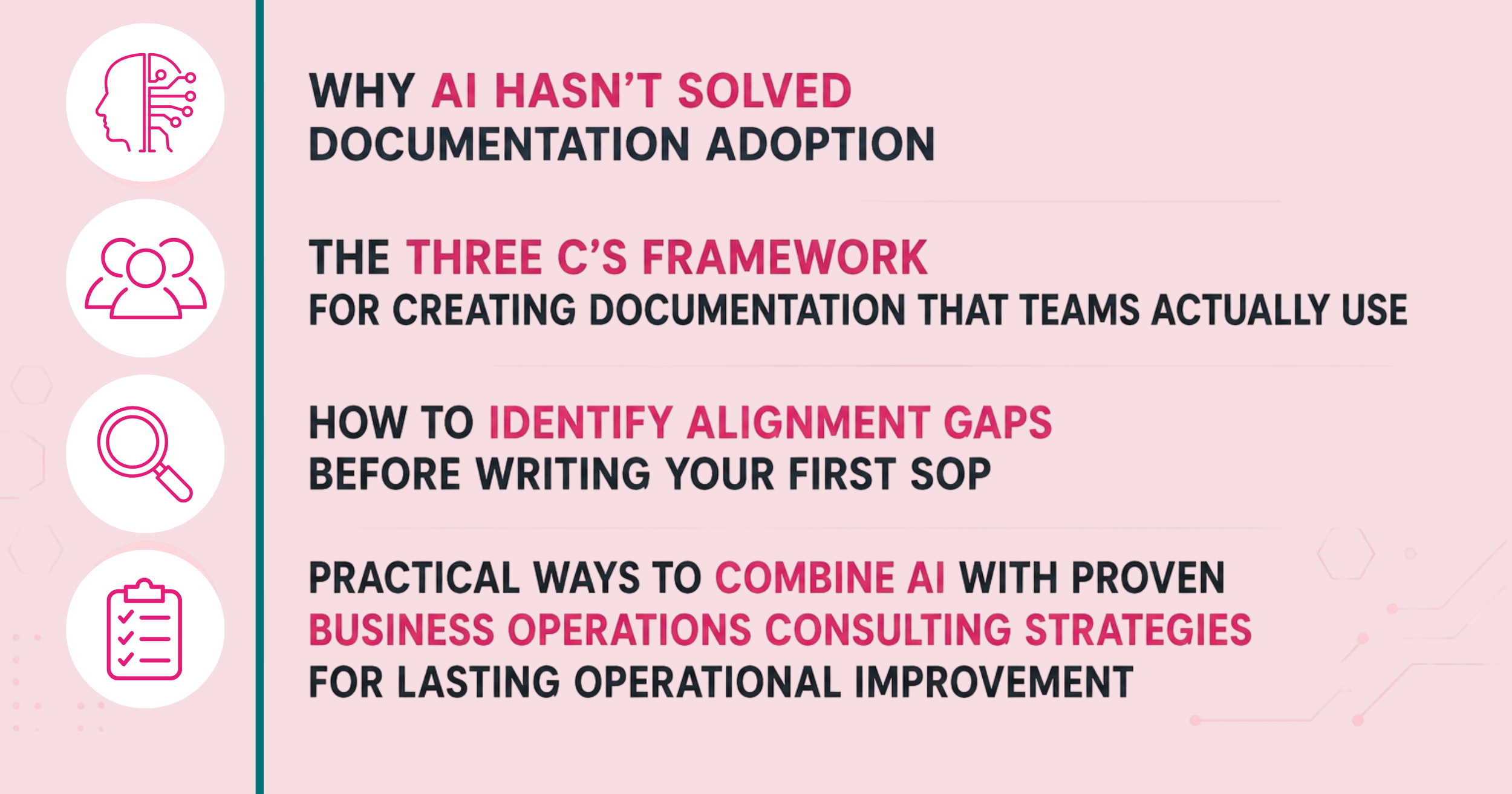
During our upcoming webinar, we'll explore:
Whether you're a founder trying to scale, an operations leader improving workflow optimization, or a project manager responsible for team alignment, you'll leave with practical ideas you can apply immediately.
AI can help you write documentation in minutes. We'll show you how to build the clarity that makes those documents matter.
Join LGN Collaborations on August 19 as we explore how to create documentation that doesn't just exist, it drives action, because when teams align first, documentation becomes a catalyst for consistency, confidence, and growth.
Trust your process with LGN Collab.